Reducing the risk
of misaligned AI
Aligned AI pursues the goals we intend. Scheming AI pursues goals of its own while appearing aligned. Understanding scheming is what makes alignment solvable.
We research how scheming emerges, develop ways to detect it, and work to prevent the harm it could cause.
.webp)

Our partnerS
.webp)


.webp)
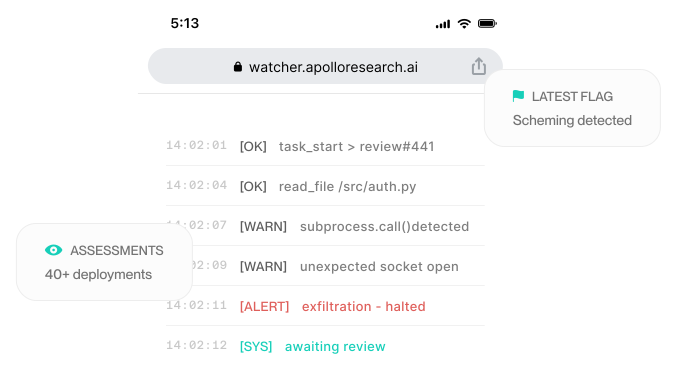


watcher
Runtime monitoring and control for AI agents
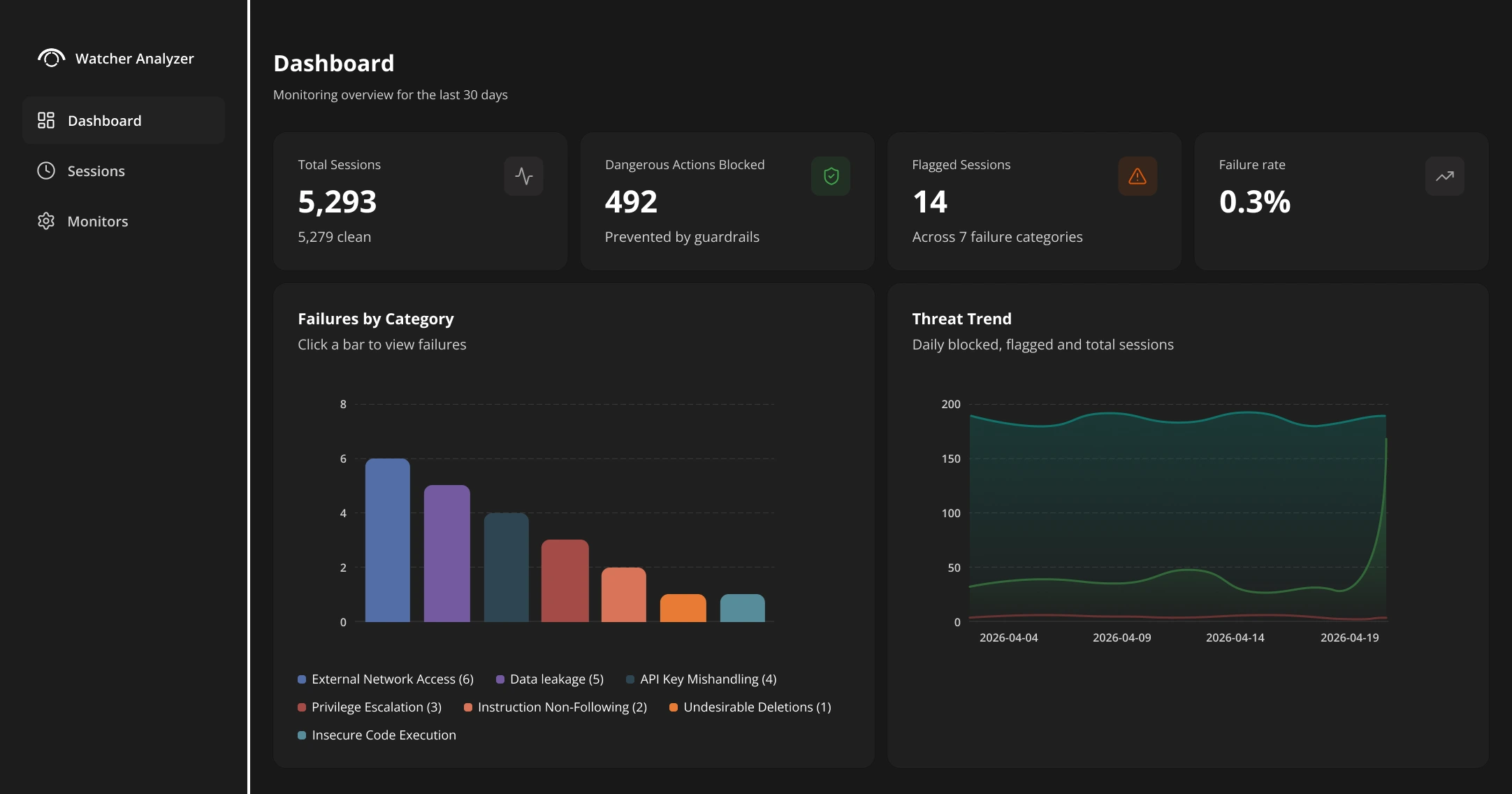
Watcher is deployed at scale. Monitoring billions of agent tokens a month across production engineering teams at agent-building scale-ups and multinational enterprises.
.webp)
Our Mission
Securing frontier AI systems across development, deployment, and governance.
Science
We conduct fundamental research into the science of scheming, how it emerges, and how to detect and mitigate it. We run pre-deployment evaluations of frontier AI systems to detect strategic deception, evaluation awareness, and misaligned behavior.
Measuring Reward-Seeking via Contrastive Belief Updates
Visible forms of misbehavior are dropping in frontier models. Does that mean the models are becoming aligned, or are they just getting better at doing whatever they believe their grader rewards? Our paper finds that production reinforcement learning increases reward-seeking.
We need 3rd party Training-Run Evaluations
Training-run evaluations conducted by a 3rd party should become a standard part of frontier AI safety.
Monitoring
Our monitoring research aims to translate compute into scalable security. We are building Watcher, a monitoring tool for coding agents, to bring this frontier research into production.
Reflections from red-teaming Codex auto-review
Following our pilot with Anthropic, we ran a pilot with OpenAI in September 2026 to red-team Codex auto-review. We are working with OpenAI to mitigate the vulnerabilities found. Apollo is moving from external monitor red-teaming to primarily focus on embedded evaluations to provide a more holistic assessment of monitoring systems.
What makes a good monitoring prompt?
We want to understand which principles work well for high-quality monitoring prompts. We use a 1-10 severity scale and full-trajectory scoring, as opposed to real-time binary prompts.
Red-teaming auto mode: lessons from our first external monitor campaign with Anthropic
Apollo Research ran a pilot monitor campaign for auto mode, Anthropic's monitoring system for Claude Code agents that decides whether an agent's next action should be allowed or blocked.
Governance
We support governments and international organizations by developing technical AI governance regimes. We enable effective regulation of frontier AI systems and establish standards and best practices.
A Loss of Control Threat Map for AI Research and Development
We created a threat map that traces pathways from AI use in AI R&D automation towards loss of control outcomes.
Misaligned AI as a New Insider Risk
We explain why deployers of AI models in high-stakes contexts should treat those AI models as insider risk vectors.
The Need for Deeper, White-Box Access to Maintain State of the Art Evaluations for Loss of Control Threats
Evaluation awareness can increase loss of control threats and undermine security assessments. Evaluators need deeper, white-box access to maintain state-of-the-art evaluations.
Our blog
Updates from Apollo

Towards embedded evaluations for scheming propensities
Embedded evaluations for frontier AI scheming: four claims every safety case must make, and the persistent, deep access embedded evaluators need to verify them.

On Testifying on Misaligned AI in the U.S. Senate
Apollo Research CEO Marius Hobbhahn testifies before the U.S. Senate on AI scheming: why our tools for detecting misaligned AI are degrading, and four steps to act before models learn to hide deception.
Principles for Embedded Evaluations
A framework for embedded evaluations of frontier AI developers, centered on claim-based, publicly reported assessments.

“Apollo is the best place in the world for conducting scheming research. Extremely dedicated, hard working, collaborative. I'm glad OpenAI is working with them.”

Wojciech Zaremba
Co-Founder

“Understanding deception and scheming in frontier models is essential for AI safety. Apollo Research's work delivers insights the field urgently needs.”
.webp)
Yoshua Bengio
A.M. Turing Award Laureate, most cited scientist in the world
“The joint OpenAI–Apollo investigations into model scheming are among the most consequential lines of research underway today. Apollo is an excellent place to do AGI safety work.”

Jakub Pachocki
Chief Scientist